
How to Dry 3D Printer Filament
Most FDM filaments pick up moisture from the surrounding air, but how quickly depends heavily on the polymer. Nylon, PVA, BVOH and TPU are far more sensitive than typical PLA, and even PETG can start causing trouble after sitting out for a while.
Once a spool is wet, dropping it into a box with desiccant is not enough. The absorbed water has to be driven out again with controlled heat. The right temperature and time depend on the material and the specific product, so the filament manufacturer's recommendation always comes first.
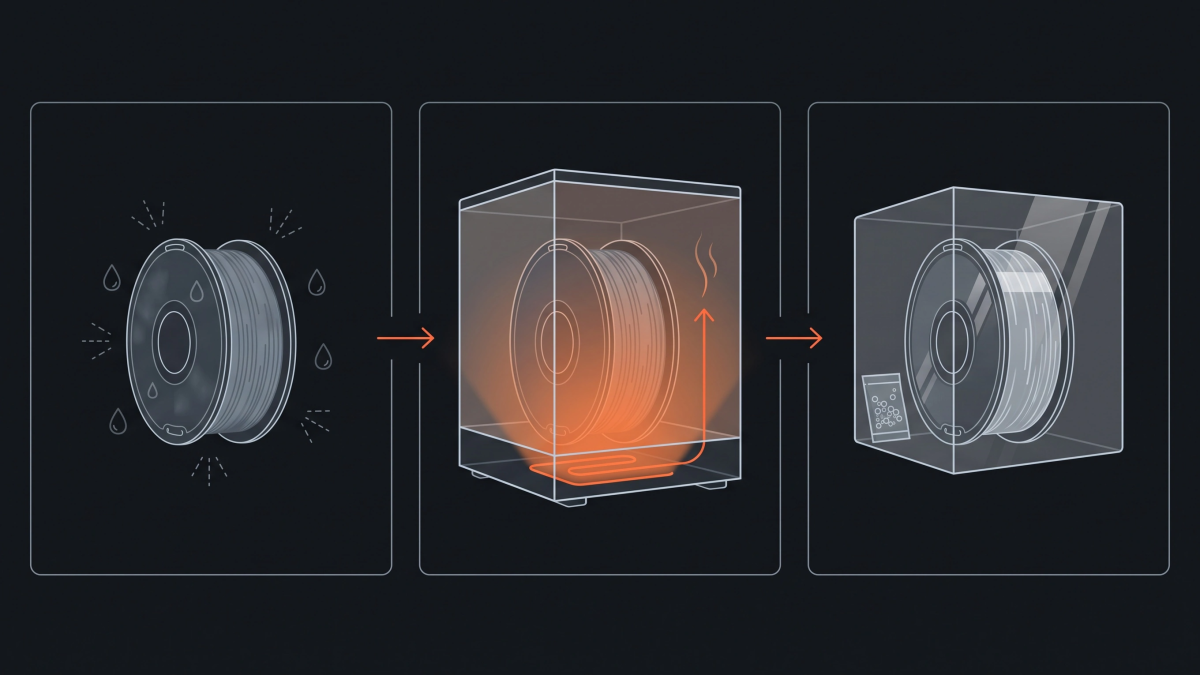
Hotter is not better. Too much heat can damage the filament or the spool. Follow the manufacturer's figure and dry with a device whose temperature you can actually control.
Why filament gets wet
Most filaments are hygroscopic to some degree: they draw water out of the air and hold it inside the material, not just on the surface. When that filament reaches the hot nozzle, the trapped water turns to steam almost instantly. That disrupts the flow of plastic and leaves marks in the print.
How much moisture a spool takes on depends on the polymer, the manufacturer's formulation, the humidity in the room and how long the spool was left exposed. A spool that has hung next to the printer for weeks is an obvious suspect, but a freshly opened one can be damp too, for example if the packaging was not properly sealed.
Signs your filament is wet
Common signs of moisture include:
- crackling or popping at the nozzle
- small bubbles in the extruded strand
- rough or uneven surfaces
- unusually heavy stringing
- weaker layer bonding
- small holes or pockmarks in the surface
- inconsistent extrusion
None of these proves moisture on its own. The wrong print temperature, poorly tuned retraction, incorrect flow or a partially clogged nozzle can look very similar. Our guide to wet filament explains how to tell these causes apart and how to confirm moisture with a simple before-and-after test.
Typical drying temperatures and times
Treat the values below as starting points, not universal rules. The figures for PLA, PETG, TPU and ASA are the ones Prusa gives for its own filaments; the other rows are common starting values. For the spool in your hand, its manufacturer's data sheet is what counts.
| Material | Typical temperature | Typical time | Moisture sensitivity |
|---|---|---|---|
| PLA / rPLA | approx. 45 °C | approx. 6 h | low to medium |
| PETG | approx. 55 °C | approx. 6 h | medium |
| TPU | approx. 60 °C | approx. 4–6 h | high |
| ASA | approx. 80 °C | approx. 4 h | medium |
| PC / PC blend | approx. 85 °C | approx. 5 h | high |
| PA / nylon | often approx. 70–90 °C depending on type | several hours | very high |
| PVA / BVOH | highly product-dependent | highly product-dependent | very high |
| CF/GF composites | per base polymer | per base polymer | per base polymer |
For fibre-filled filaments such as PLA-CF or PA-CF, the base polymer decides: a carbon-fibre nylon is dried like nylon, not like PLA. Actual drying time also depends on how wet the spool is and how well your device moves air. A thoroughly soaked nylon spool can take considerably longer than the table suggests.
Material guides: PLA, PETG, TPU, nylon, polycarbonate and water-soluble filament.
Why the temperature matters
Too cool, and the filament dries very slowly or barely at all. Too hot, and the material softens: the windings can fuse together, the filament can deform, and the spool itself may warp. A spool with fused windings often will not unwind cleanly any more.
So "as hot as possible to speed things up" is a bad rule. Stick to the manufacturer's figure, or the cautious value from the table if there is none, and extend the time rather than raising the temperature.
Before you start
Check three things before a spool goes in:
- The filament maker's guidance: is there a drying recommendation on the box, in the data sheet or on the website? It overrides any general table.
- The spool material: most spools are plastic, some are cardboard. Not every spool tolerates every temperature, especially for materials that are dried hot.
- Your dryer: can it reliably reach the temperature you need, and does the spool fit its diameter and width?
Filament dryers: the controlled default
An active filament dryer combines regulated heat with air exchange, so the moisture leaving the filament is actually carried away. For most people it is the most controlled and convenient way to dry filament.
What to look for in a dryer:
- a maximum temperature high enough for your materials
- reliable temperature control
- air exchange or some other way of removing moisture
- a timer
- room for your spool size
- capacity for one or several spools
- the option to print straight from the dryer
Detailed buying criteria and a selection of devices are in our filament dryer guide.
Choose a filament dryerDrying is not the same as dry storage
A passive dry box with desiccant keeps dry filament dry and slows down how fast it absorbs new moisture. It is not a dryer, though: water that has already soaked deep into the material will not reliably come back out.
The sensible order is to dry wet spools actively, then keep dry spools dry passively. Our comparison dry box vs filament dryer explains which device does which job, and storing filament covers how to keep spools in good condition long term.
What about a kitchen oven?
The kitchen oven is the obvious thing to reach for, but it is not a good default. Household ovens are built for much higher temperatures and are often imprecise at the low end: they can overshoot the set temperature and swing around it, and areas near the heating elements run hotter than the rest. For a material that can fuse or deform a few degrees too hot, that is a real risk.
A dedicated filament dryer is the more controlled choice. We explicitly advise against drying filament in a kitchen oven.
Warning: if you use an oven anyway, you do so at your own risk. At the very least:
- Never leave it unattended. Overheated plastic can melt, release fumes and, in the worst case, start a fire.
- Check the real temperature with a separate thermometer. The oven's own setting is not reliable at the low end.
- No grill, no top heat. Keep the spool away from the heating elements.
- Watch plastic spools. Many spools deform at temperatures the filament itself would still tolerate.
- Not in an oven you are cooking food in at the same time. Ventilate the room and the oven well.
If you dry filament regularly or print sensitive materials such as nylon, TPU or water-soluble filament, a filament dryer is always the better investment than the oven.
After drying
Dry filament only stays dry if you protect it afterwards:
- Dry the spool according to the manufacturer's guidance.
- Print right away or put it in a dry box, ideally printing straight from the dry box or dryer.
- After printing, store it sealed with desiccant again.
- Regenerate or replace silica gel regularly once it is saturated.
Stick to this routine and you will need to re-dry the same spool far less often.
Frequently asked questions
How long does filament need to dry?
It depends on the material and how wet the spool is. Many typical cycles take several hours, with around six hours as a starting point for PLA and PETG. Heavily soaked nylon can take longer. The manufacturer's guidance takes priority.
What temperature should I use to dry PLA?
Around 45 °C is a common starting point, and it is the figure Prusa gives for its own PLA. PLA softens at fairly low temperatures, so be especially careful here and check the manufacturer's recommendation.
What temperature should I use to dry PETG?
Around 55 °C for roughly six hours is a common starting point. The data sheet for your spool takes priority.
Can a dry box dry wet filament?
A passive dry box with desiccant is mainly meant to keep filament dry. Filament that is already wet should be dried in an active dryer first and only then go into the dry box.
Is new filament straight out of the bag always dry?
Not necessarily. A vacuum-sealed spool with desiccant is usually in good shape, but "fresh from the packaging" is no proof. If a new spool shows typical moisture symptoms, a drying cycle is worth trying.
Can I dry filament in a kitchen oven?
We explicitly advise against it. Household ovens are often imprecise at low temperatures and have hotspots. Filament and spool can melt or deform, overheated plastic can release fumes, and an unattended oven becomes a fire risk. A filament dryer is the safe, controlled option.
Build a part with Vuolti: Go to the 3D generators