
Heat-set inserts: durable threads in 3D printed parts
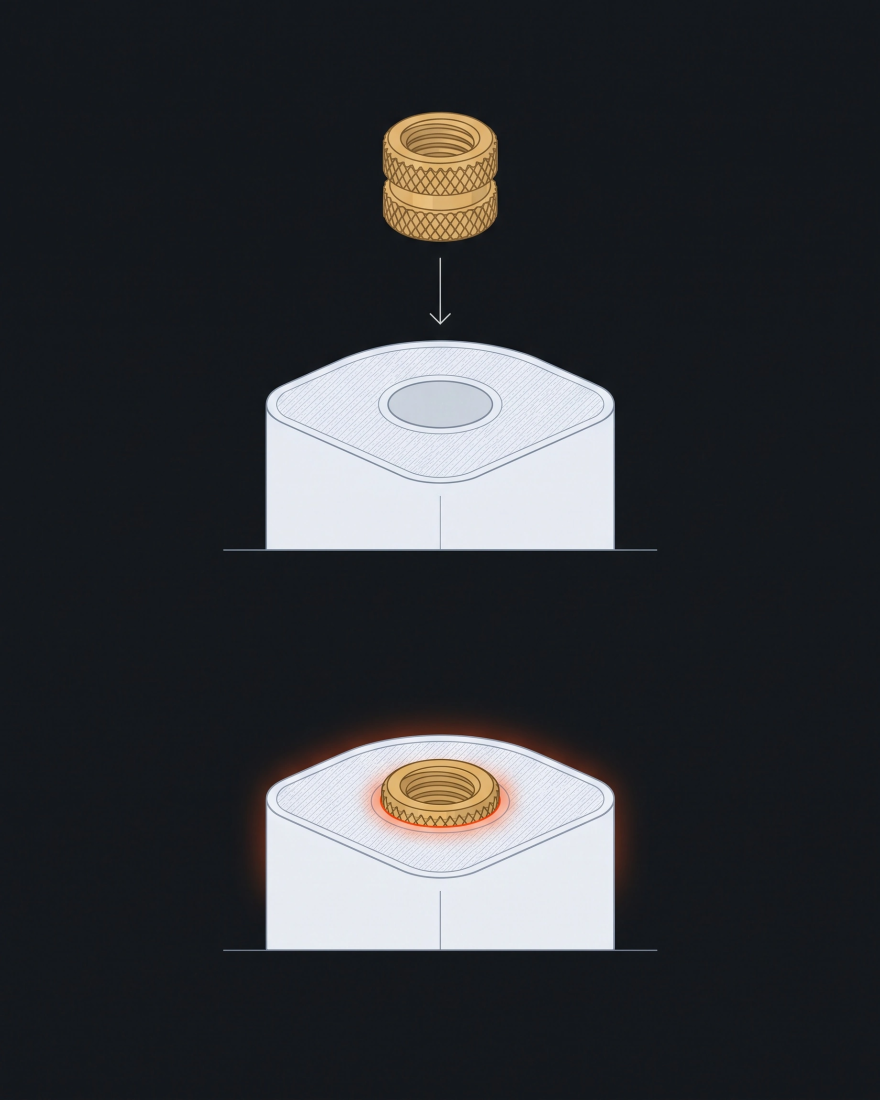
Heat-set inserts are brass threaded inserts installed into thermoplastic 3D printed parts using heat. They are useful when a part needs to be assembled and disassembled repeatedly without wearing out a thread cut directly into plastic. The critical factors are correct hole size, enough surrounding material and controlled installation.
When are inserts useful?
Heat-set inserts are particularly useful for:
- housings with screw-on covers
- parts that are frequently disassembled
- brackets
- mounting plates
- repeated screw connections
Not every printed hole will fit
The required hole diameter depends on insert geometry, manufacturer, material, printer and print orientation. The insert manufacturer's dimensions are a starting point, not a guarantee of the actual printed hole size. CNC Kitchen has shown that printed holes can come out smaller than their nominal CAD diameter, which makes test holes useful before committing to a final part.
- insert geometry
- manufacturer
- material
- printer
- print orientation
Print a test strip first
For a new insert, print 3–5 holes with slightly different diameters. Check whether:
- the insert can be positioned before heating
- excessive plastic is not pushed out
- the insert remains centred
- enough wall material remains around it
Installation
Basic process:
- place the insert straight
- heat it with a suitable installation tip
- press it in slowly and under control
- do not push it through the part
- let the plastic cool
Temperature
Do not define one universal temperature. CNC Kitchen suggests using a controlled temperature somewhat above the relevant material's printing temperature as a practical starting point. Always consider the insert, filament and tool manufacturer's guidance.
Hole geometry
Useful design principles:
- straight hole
- sufficient depth
- enough material around the hole
- do not place the insert directly against a thin outside wall
Resin is different
Heat-set inserts rely on softening thermoplastic material. That is not the same process in cured resin parts. This guide is primarily about FDM/FFF thermoplastics.
What to look for when buying
For an insert set, look for clearly documented sizes, available technical dimensions, useful screw sizes and understandable hole recommendations. For an installation tip, look for compatibility with the insert geometry, temperature resistance and a matching soldering-iron connection. Do not rank products by commission.
- Insert set: clearly documented sizes
- Insert set: technical dimensions available
- Insert set: useful screw sizes
- Insert set: understandable hole recommendations
- Installation tip: compatible with the insert geometry
- Installation tip: temperature-resistant
- Installation tip: compatible with the intended soldering iron or installation tool